Tuesday, February 19, 2013

A Cup of Heat, Monsieur?

Pierre-Simon de Laplace and Antoine-Laurent de Lavoisier
thought that heat was an invisible liquid.
18th century physicists thought of heat as something much like electricity: an invisible fluid that could flow through other materials or soak into them. They named this hypothetical fluid ‘caloric,’ and it was thought to be a distinct form of material, like air or water, only different. If an object had absorbed a lot of caloric, like a sponge soaking up water, then it was hot. If the caloric drained out, the object cooled.

This was a sensible theory. We all know that objects can become electrically charged and that this changes their properties. A charged balloon can stick to the ceiling, or make your hair stand on end; a charged metal sphere can give you a zap. Electric current really is an invisible fluid, composed (most usually) of material particles called electrons. Most of the time they are bound up in atoms, but when they come loose they can flow into things, or out of them or through them. Things can become charged by soaking up extra electrons.

Soaking up electric charge. 
(Image by Wikimedia user Dtjrh2, 
used under Creative Commons license.)
In a similar way, it would seem, objects can also soak up heat. Hot objects may expand or cause burns, just as charged objects stick to ceilings or shock people. Heat flows from high to low temperatures, just as electricity flows from high voltage to low. Appealing as it is at this basic level, the analogy turns out to work well even in finer detail. Antoine Lavoisier and Pierre Laplace developed an extensive body of caloric theory that was able to explain heating and cooling and many other thermal phenomena with quantitative accuracy. 

So in the eighteenth century it only made sense to think of heat as something similar to electrical charge. In the following century, heat engines and electric motors would be developed in parallel, and engineers would still think of them in similar terms. Today again people are deciding whether to have a car powered by an electric motor instead of a combustion engine, and the differences seem to be ones of practical detail. 

Today we no longer believe that heat is a material fluid, however. Why not? It's not really as clear-cut an issue as textbooks often make it seem, because today our concept of matter is not as simple as it once was. We know that not even electrons are really these indestructible little specks of hard stuff: they can be created and destroyed in high-energy collisions. And in a lot of ways we still treat heat as if it were a material fluid.

The bottom line, though, is that even though electrons can be born and die, electric charge can't. If electrons appear or disappear they do so together with positrons, so that the net change in charge remains zero. The only way for an object to become charged is for charge to flow into it from elsewhere—or for opposite charge to flow out of the object. There is no way to simply create charge from stuff that is not charge. Heat, in contrast, can flow into or out of things—but that's not the only way to get heat. One can also create heat, without importing it or already having it. It's called friction.

Rub your hands together. Feel it? That's heat. 

You didn't just create any new material substance from nothing. Big Bangs and particle colliders aren't as easy as that. So heat is not a material fluid. What is it, then?

Whatever heat is, you've just made some. It's right there in your hands.

Thursday, February 14, 2013

Fire Glows

It's not just bright.
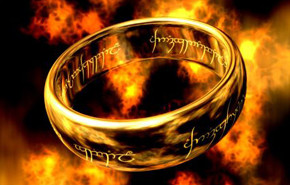
Humans discovered fire a long time ago, but for most of that time we only used it for warmth and light and cooking, rather as Bilbo Baggins used his magic ring for years just to avoid unwanted callers. Only in the 18th century did James Watt show up to play Gandalf, and reveal that our curious little trinket was the One Ring to rule them all. Fire has enormous power.

Even after centuries of technological progress since Watt, we still find it very hard to beat combustion as a source of power. Burning a tank of fuel releases enough energy to lift cargo all the way to the Moon, even with the horrible inefficiency of a rocket engine. Combustion provides energy, as one says, to burn. Why is fire such a tremendously greater power source than, say, clockwork springs or a windmill? I’ve never seen a clear answer to this question in any physics text, but I think I have found a succinct one of my own. 

Fire glows.
Light oscillates really fast.
The fact that fire glows demonstrates that fire is releasing energy from motions (of electrons in chemical bonds) with frequencies in the range of visible light. Those are very high frequencies, around 1014 cycles per second. As Planck taught us, energy is proportional to frequency. So if human energy needs are for motion at up to a few thousand RPMS, mere hundreds of cycles per second, combustion lets us tap energy resources on a scale greater by a factor of a million million. Combustion delivers so much energy, because molecular frequencies are so high.

This is what an engine somehow does.
It isn’t easy to gear all that power down by a factor of 1012 so we can use it, though. Electrons whir around in molecules far too fast for our eyes to follow. We can’t just throw a harness over them. Even if we could, they are very light in weight. They bounce off things, rather than dragging them along. To tap them for power, we need some clever way of gently bleeding off their enormous but very rapidly whirring energy, a tiny bit at a time.  There's more to it than just installing an awful lot of tiny gears. 

Getting fire to do work means transferring power across a huge frequency range. That's what thermodynamics is all about. The reason that thermodynamics doesn’t seem very much like the rest of physics is that energy transfer across a huge frequency range is an extreme case, in which certain otherwise obscure aspects of physics become very important. That makes them important in general, though, because high frequencies can deliver so much power. It's well worth learning how thermodynamics really works.

Raising Water by Fire

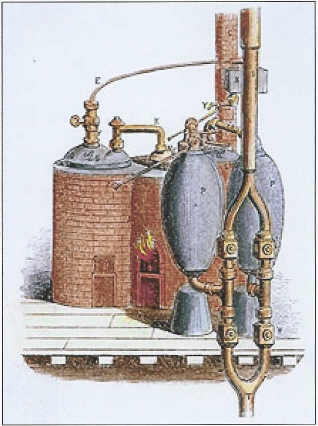
James Watt dramatically improved the steam engine, but he didn’t invent it. In his time, steam engines were already a practical and economical success. The machines of Thomas Newcomen and Thomas Savery had already begun the new era in human technology. 

Savery had a head for marketing as well as for steam. In 1702 he produced a pamphlet advertising his device as “An Engine to Raise Water By Fire”. His description may have been poetic, but it was literally exact. His engine pumped water by burning coal. Its killer application was draining coal mines. 

Humans may have discovered fire in distant prehistoric times, but the really useful thing about fire was only discovered in the 18th century. Never mind cooking or smelting metal or scaring wolves: fire can raise an awful lot of water. And if you can raise water, you can do pretty much anything, because raising water means you can exert force.

Savery’s and Newcomen’s engines were crude and simple, and by that I don’t mean that they were primitively made, rattling too much or leaking steam. They were just stupid designs, compared to Watt’s machines. They didn’t even use steam pressure to actually do their work, but just let the steam balance atmospheric pressure. Then they condensed the steam, by shooting in cold water, and let the suddenly unbalanced atmospheric pressure do the work. Savery’s engine didn’t even turn any moving parts, but just sucked water through pipes. It wasn’t so much more than a proof of concept, like the aeolipile.

Hindsight is 20/20, of course, and it’s not really fair to call Savery and Newcomen stupid. Watt’s proper steam-pressure engines also needed stronger boilers. The point is that even the crudest engines were such a quantum leap in power technology, compared to wind, water, or animal power, that they rapidly changed the world. In effect they turned lumps of coal into unprecedentedly huge amounts of practical work. Up until 1775, the Russian navy had been using two enormous windmills to drain its dry docks at Kronstadt; each time they drained the docks in order to work on a ship, the draining job took a year. When they installed a single Newcomen engine, it did the job in two weeks.

With coal-fired steam engines, the human capacity to exert physical force suddenly soared. Even today, the biggest problem with changing to power sources other than combustion is that fire can provide so much more power than, say, sunlight or wind. We humans keep thinking wistfully about switching away from combustion, to some form of clean energy, but we really want to maintain our current energetic lifestyle. We're like a big city lawyer who wants to quit the firm and become a social worker, but also wants to keep up the mortgage payments.

Why is fire so very good for raising water? I have some thoughts on this, based on the fact that fire glows.

Thursday, April 26, 2012

Vitruvian Machine

Sometime in the late first century BCE, the Roman architect Marcus Vitruvius Pollio described the oldest known steam engine: the aeolipile. Devices of this type were described again in the following century by Hero (or Heron) of Alexandria, who gave more detail about their construction. Aeolipiles were hollow metal tanks with angled vents, filled with water and mounted on a pivot over a fire. When the water inside the tank boiled, the jets of steam hissing out through the vents would make the whole tank spin.

While the later Hero is remembered more often than the earlier Vitruvius in connection with these ancient gadgets, Hero himself refers to even earlier work on them by another Alexandrian, Ctesibius. No writings by Ctesibius have survived, and although later writers attributed several inventions to him, they do not mention the aeolipile as one of them, so the actual inventor may have been even more ancient.

Hero’s explanations imply that aeolipiles were temple showpieces whose rotation astounded but did nothing useful. There are no records or remains to suggest that any form of steam power was ever applied practically in ancient times. But Vitruvius had a different notion of what aeolipiles were good for. He referred to the aeolipile almost as an ancestor of the particle accelerator: “a scientific invention” which could be used to “discover a divine truth lurking in the laws of the heavens.”

Vitruvius was still a classical writer. The book in which he mentions the aeolipile also expounds the theory of architectural proportion, based on the human form, whose illustration by Leonardo da Vinci would become the Renaissance icon of classical humanism: Vitruvian Man. Vitruvius had no idea of the enormous practical potential of steam engines. He mentions the aeolipile in a chapter on weather. The truths he learned from the spinning tank of steam were about wind, not heat and power.

The aeolipile was a toy. It could barely turn itself, much less produce the labor power of a single slave. A far greater advance in power technology than the aeolipile was the medieval invention of the collar harness, which let horses replace oxen as draft animals. The uselessness of the aeolipile is an excellent example of the vastly under-appreciated role of materials in technological development. Whoever invented the aeolipile was a brilliant scientist, who must at least partially have understood deep principles of force and reaction, and then made them work in a real device; but it would be two thousand years before vessels could be forged that would hold enough pressure to let steam power change the world.

Nevertheless the aeolipile did indeed demonstrate a divine truth lurking in natural law. It may not have shown just how much power a machine could deliver, but it showed that a machine could have power to move. It hinted at the future power of artificial heat engines to do work beyond the limits of the human body.

Wednesday, April 21, 2010

What is heat?


Heat is amazing. The energy you could in principle extract, by lowering the temperature of any amount of water by a barely perceptible one degree Celsius, would be enough to lift that same amount of water to a height of over four hundred meters. And the energy you could extract by condensing any amount of steam into liquid water would be enough to lift that same amount of water into space. This is why the Industrial Revolution was such a big deal. Harnessing heat, in fuel-burning engines that drive pistons or spin turbines with hot gases, is what has let us hair-challenged primates conquer the planet. Heat is magic. What is it?

Until the mid 19th century, people thought that heat was a special kind of fluid, like air or water but different, and invisible. They called it "phlogiston", or "caloric". Some considered that cold was a distinct fluid, "frigoric", while others argued that cold was simply absence of heat. These were by no means stupid or crazy theories. Electrical charge is a phenomenon which is about as basic and important as heat, and it really is carried by two different kinds of stuff, namely electrons and protons (as well as other much less common particles), which each carry opposite charge. Objects can become positively or negatively charged if they pick up excess protons or electrons. It was not silly to imagine that objects might become hot or cold by picking up excess caloric or frigoric.

But early physicists figured out that this was wrong, mainly from carefully observing how grinding metal keeps on making it hotter, even when the grinder and the metal are kept well apart from any other objects that might conceivably be able to inject a steady supply of caloric into them. They concluded that heat is actually some form of energy, and that the more familiar kinds of energy carried by moving objects can be converted into heat, through friction; while heat may in turn be converted into motion and useful work, in engines.

But then just what is the difference between heat and work, as forms of energy? It's not easy to get a straight answer even from a fully trained physicist, because the truth is that we're still not completely sure what heat is. If I have many bazillions of atoms all zipping around in a big box, bouncing rapidly off each other and the walls, making up a gas, then I can use statistical mechanics to say an awful lot about heat and pressure and temperature for this gas. But if I have one single atom, perhaps ionized and trapped in a strong electric field, I know that the concept of heat is not even relevant. With one atom, I can compute the motions of its nucleus and of its electrons, rather as I worked out the motion of solid objects in freshman physics. It does not even make sense to ask whether the atom is hot or cold. Usually no single atom has heat, but a billion atoms do. So heat is somehow an emergent property of large numbers of atoms together.

"Emergent property" is a fine bit of fashionable philosophical mumbo-jumbo, which spends rather too much time in the blogs of wild-eyed crackpots and tenured philosophers, to be comfortably welcome among respectable scientists. But in the case of heat, you can slurp an emergent property from a cup of coffee. Heat rules the world. It's quite concretely real. So what is it?

Well, we're working on it. There is ample precedent in perfectly well understood physics for new behavior to emerge in larger systems; it's just that in this particularly fundamental case of heat there are still some major obscurities in exactly how it works. But in just the past few years, atomic and optical physicists have gained the capability to make extremely precise and direct measurements on small samples of gas, with only hundreds to thousands of atoms. If heat emerges, we're soon going to be able to catch it in the act. Watch this space.

Sunday, June 14, 2009

Statistical Mechanics

Most people these days have heard of quantum mechanics, and how it somehow brings chance and probability into physics on a basic level. This is a misleading truth, because actually quantum mechanics is perfectly deterministic, and not probabilistic at all, until we come to measure anything. Then the probabilities come in, and only then. The problem is that quantum measurement is a very subtle thing that is far from fully understood. And one thing we do know is that inferring how things really are, from how things look, is uniquely tricky in quantum mechanics.

To appreciate the subtlety of quantum mechanics, it helps to know about the older and less tricky place that probability has in physics: statistical mechanics. I doubt that most non-physicists have ever heard of statistical mechanics. In many places one can even earn a Bachelor's degree in physics without ever taking a course in it. This is unfortunate, because statistical mechanics is so important, that a physicist who doesn't know about it is like a Scout who doesn't know that fire needs air. Statistical mechanics is a sort of post-processing stage that has to be performed on virtually all the rest of physics — even including quantum mechanics — in order to make sense of anything but the very simplest and most controlled experiments.

Mechanics without statistics is the physics we learn in school. A rock flies through the air, falling under gravity. Ignore air friction, and model the rock as a point with a given mass — a particle. Apply Newton's Laws to particles: that's mechanics.

'In principle,' we may be told, 'the universe is a large number of particles, governed by Newton's Laws.' In practice, of course, most of these particles are beyond our control, beyond our observation, or at least beneath our notice. We do not see the vast swarms of air molecules that surround us and fill our lungs. And even if we could mark their paths, solving Newton's equations for so many interacting particles is far beyond our computational power. Thus do we see the vast gap between the pristine principles of physics, and the practical real world.

Bah. Physics doesn't care about pristine. Sure, part of physics is about trying to reduce everything, 'in principle', to some elegant little Theory of Everything. We're writing one big long footnote to Plato, who wanted everything to boil down to the five regular polyhedra. But that whole grand unified simplicity thing is really the hood ornament of physics, not the engine. The thing that drives physics is putting principles into practice, and codifying practice into principle. So no, the fact that we can't follow every atom does not make a huge gap between physics and reality. There is a whole huge branch of physics which is all about the principles and the practice of dealing with huge numbers of particles that cannot be individually observed, predicted, or controlled.

And that is the branch of physics called statistical mechanics. It uses probability theory to get the best results we can from what we do know, in spite of what we don't. Whether or not God plays dice with the universe, physicists do, to make up for the fact that we're not God.

Saturday, May 30, 2009

Time Reversal

Physics is conflicted about whether the future is fully determined and just waiting for us to reach it, or is perhaps at least partly undetermined. The undetermined viewpoint is represented in statistical mechanics, and to some extent in quantum mechanics. The deterministic position is taken by all the rest of physics, including most of quantum mechanics. This raises questions about whether physics supports predestination or free will, but I don't want to look at these now. I want to focus instead on the difference between future and past. Why can't I remember tomorrow?

Most of physics says that future and past are both completely determined by the laws of nature, and so are both equally and completely definite. Most of deterministic physics even goes so far as to have 'time reversal symmetry' — the future and the past are fully equivalent. This really makes it hard to see why I can't remember tomorrow.

Time reversal symmetry is a startling fact. Suppose I have a system in an initial state — for example, a piece of paper that has just been touched by a flame. Over some time interval, the system develops (physicists usually say 'evolves', though this has nothing to do with Darwin) into some other state. In our example, the paper will of course catch fire and burn. Let's stop the clock once the flames have died down, and call the little pile of ash our final state. In fact the final state is not just the pile of ash: it includes emitted light and dust and carbon dioxide molecules, and everything that resulted from the paper burning. For simplicity we can consider the final state to contain light, smoke, and ashes, letting the smoke and light stand for everything else that is also involved. Let's imagine there are no walls around, so the flashes of light from the flames just continue flying outwards.

Burning is easy. Unburning is not.
Now consider a hypothetical 'mirror state' to this final state, in which every particle and light wave is in the same position, but moving in the opposite direction. Of course it would be very difficult to make this mirrored state in reality. It's easy to make a pile of ash surrounded by rising smoke and outgoing light. Just burn some paper. But it's hard to make a pile of ash surrounded by falling smoke and incoming light.

Still, the mirrored final state of our burnt paper is in principle a possible state of reality, as far as we can tell. Suppose we could somehow achieve it. What would happen next? If burning of paper is governed by laws that have time reversal symmetry, then what would happen would be exactly the burning process, in reverse. The light and smoke would fall inwards onto the ashes, and these would re-assemble themselves into paper. Plumes of hot gas would form over the re-assembling ashes during the unburning process, but these time-reversed flames would be only faintly visible, for they would only be emitting as much light as ordinary flames absorb; the copious light that normal flames emit, these time-reversed flames would be absorbing instead. In the end, though, the motion-mirrored ashes would have unburnt into crisp white paper.

Okay, such a bizarre process is in principle possible. Should we be surprised? In a world full of unthinkably huge numbers of particles and waves all jostling together, it may be no wonder that all kinds of things are in principle possible. We have acknowledged, however, that this unburning which is possible in principle would be difficult to achieve in practice, because it would be very hard to assemble the time-reversed mirror state of the light, smoke, and ashes. In fact it would be extremely hard, because not just any state of incoming light and smoke falling onto ash would do. We would need the precise mirrored version of the final state from burning. So all the smoke particles have to be lined up so they will fall exactly into place on the ashes, and the incoming light has to have exactly the right waveforms to meet the ashes at the right time to drive the chemical reactions to separate oxygen from CO2 and assemble the carbon into cellulose, and so on. The precision of control that would be needed is ridiculously unfeasible. Out of all the possible states that include ashes, falling smoke, and incoming light, all of which would be difficult states to create, only a fantastically tiny fraction are actually time-reversing mirror states for burnt paper.

The conclusion seems therefore to be only the reasonable one, that ashes unburning into paper is a stupendously unlikely event. Paper burning into ash, in contrast, is not at all uncommon; it is quite easy to arrange this. So, in spite of time reversal symmetry, there remains a clear difference between past and future. Yesterday's paper becomes tomorrow's ash, and never the other way around, because paper that is about to burn into ash is nothing special, while ash that is about to unburn — that is, the time-reversed mirror state of freshly burnt paper — could only be a fantastically fine-tuned set-up.

But here's the point. For every initial state of paper that is about to burn into ash, there is a precise final state of ash, rising smoke, and outgoing light. For every such state there is a precise mirror state of ash, falling smoke, and incoming light. And that is a state of ash that is about to unburn into paper. So for every possible initial state of paper that is about to burn into ash, there is a state of ash that is about to unburn into paper; and conversely, there are only as many ways to burn paper as there are to unburn it. So how can burning be nothing special while unburning is fantastic? How can it be that paper-about-to-burn states are so much more commonly seen than ash-about-to-unburn states? There are exactly as many of each kind of state, for they match one-to-one. If one kind of state counts as a fantastically fine-tuned set-up, why is the other one any less bizarre?

How can it be that burning is so much more common than unburning? Obviously it is. But why?

This is the puzzle of time reversal symmetry.