Showing posts with label engines. Show all posts

Friday, January 13, 2017

Humphrey Potter and the Ghost in the Machine

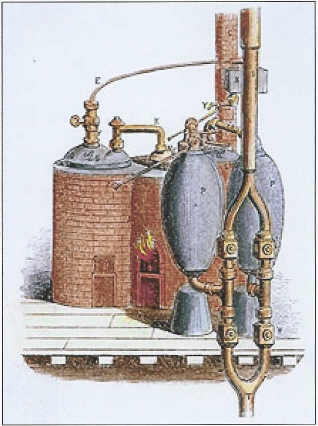
Humphrey Potter adds strings to Mr Newcomen's engine so that he can go play.
The first steam engines were slow-working beasts that needed constant human tending. To work its minutes-long cycle, the first Newcomen steam engine needed a human hand to open and close valves for cold water and steam. The machine provided great power, but someone had to control it.

At some point, however, some brilliant mechanical mind noticed that the machine was, after all, creating its own motion. Why not connect the moving piston to the valves, and let the engine run itself?

Some sources even claim to identify the person who first made this brainstorm work: a young boy named Humphrey Potter, who was paid to operate a Newcomen engine by hand. Young Potter hooked up a system of “strings and latches” that made the machine itself do his work for him. Then he ran off to play.

Apparently the sources for this story are not considered reliable. I can’t find any of them myself, and the modern texts that mention Humphrey Potter refer to his story as a legend. That’s a shame, because I’d like to think I could put a name to the person who first made a useful engine run all by itself. 

Apart from the practical advantages of getting a machine to run itself, the scientific point of lazy Potter’s clever trick is that it took any form of intelligence out of the loop of doing work. The entire engine process, from fuel combustion to pumping water, was now a purely mechanical operation. Humphrey Potter banished the ghost from the machine. He made it clear that everything that was occurring, in the marvelous process that turned lumps of coal into useful work, was occurring strictly under the basic laws of physics. It all ran all by itself.

In one way we take this insight for granted now, and may even extend it to processes more complex than lifting weight by burning coal, processes like life and consciousness. Yet in a very practical sense science still has not fully taken the point that engines can run as closed systems, without external power or control, and without any ingredients beyond basic physics. Engineers invoke higher level concepts like pressure and temperature, and while these are clearly valid, they leave a lot of details hidden under the hood. Theoretical physicists analyze parts of the whole process, like how gas particles adapt their motion when a piston moves in a predetermined way, but they do not simultaneously consider how the piston motion is itself determined by the gas particles bouncing off it. We don’t really believe there is any ghost in the machine, but when we have to explain how the machine works, somehow we keep sneaking the ghost back in, in some form or other.

If there's something strange
in your phase space neighborhood ...
At least, until now. Quite recently we have discovered a very simple mathematical model for a minimal kind of combustion engine, that runs as a closed system under basic physics. So we now have a bare-metal, first-principles model for an engine. Its operation is in some ways very reminiscent of a steam engine, but in other ways it is radically different. We are hoping that it may teach us about the microscopic roots of thermodynamics, but someday, perhaps, it might be the basis of a whole new class of power nanotechnology.

Readers who know Hamiltonian mechanics may enjoy our first paper on this subject. "Hamiltonian analogs of combustion engines: A systematic exception to adiabatic decoupling" is published in Physical Review E 94, 042127 (2016), and is also available in e-print form at https://arxiv.org/abs/1701.05006.


Thursday, February 14, 2013

Fire Glows

It's not just bright.
Humans discovered fire a long time ago, but for most of that time we only used it for warmth and light and cooking, rather as Bilbo Baggins used his magic ring for years just to avoid unwanted callers. Only in the 18th century did James Watt show up to play Gandalf, and reveal that our curious little trinket was the One Ring to rule them all. Fire has enormous power.

Even after centuries of technological progress since Watt, we still find it very hard to beat combustion as a source of power. Burning a tank of fuel releases enough energy to lift cargo all the way to the Moon, even with the horrible inefficiency of a rocket engine. Combustion provides energy, as one says, to burn. Why is fire such a tremendously greater power source than, say, clockwork springs or a windmill? I’ve never seen a clear answer to this question in any physics text, but I think I have found a succinct one of my own. 

Fire glows.
Light oscillates really fast.
The fact that fire glows demonstrates that fire is releasing energy from motions (of electrons in chemical bonds) with frequencies in the range of visible light. Those are very high frequencies, around 1014 cycles per second. As Planck taught us, energy is proportional to frequency. So if human energy needs are for motion at up to a few thousand RPMS, mere hundreds of cycles per second, combustion lets us tap energy resources on a scale greater by a factor of a million million. Combustion delivers so much energy, because molecular frequencies are so high.

This is what an engine somehow does.
It isn’t easy to gear all that power down by a factor of 1012 so we can use it, though. Electrons whir around in molecules far too fast for our eyes to follow. We can’t just throw a harness over them. Even if we could, they are very light in weight. They bounce off things, rather than dragging them along. To tap them for power, we need some clever way of gently bleeding off their enormous but very rapidly whirring energy, a tiny bit at a time.  There's more to it than just installing an awful lot of tiny gears. 

Getting fire to do work means transferring power across a huge frequency range. That's what thermodynamics is all about. The reason that thermodynamics doesn’t seem very much like the rest of physics is that energy transfer across a huge frequency range is an extreme case, in which certain otherwise obscure aspects of physics become very important. That makes them important in general, though, because high frequencies can deliver so much power. It's well worth learning how thermodynamics really works.

Raising Water by Fire

James Watt dramatically improved the steam engine, but he didn’t invent it. In his time, steam engines were already a practical and economical success. The machines of Thomas Newcomen and Thomas Savery had already begun the new era in human technology. 

Savery had a head for marketing as well as for steam. In 1702 he produced a pamphlet advertising his device as “An Engine to Raise Water By Fire”. His description may have been poetic, but it was literally exact. His engine pumped water by burning coal. Its killer application was draining coal mines. 

Humans may have discovered fire in distant prehistoric times, but the really useful thing about fire was only discovered in the 18th century. Never mind cooking or smelting metal or scaring wolves: fire can raise an awful lot of water. And if you can raise water, you can do pretty much anything, because raising water means you can exert force.

Savery’s and Newcomen’s engines were crude and simple, and by that I don’t mean that they were primitively made, rattling too much or leaking steam. They were just stupid designs, compared to Watt’s machines. They didn’t even use steam pressure to actually do their work, but just let the steam balance atmospheric pressure. Then they condensed the steam, by shooting in cold water, and let the suddenly unbalanced atmospheric pressure do the work. Savery’s engine didn’t even turn any moving parts, but just sucked water through pipes. It wasn’t so much more than a proof of concept, like the aeolipile.

Hindsight is 20/20, of course, and it’s not really fair to call Savery and Newcomen stupid. Watt’s proper steam-pressure engines also needed stronger boilers. The point is that even the crudest engines were such a quantum leap in power technology, compared to wind, water, or animal power, that they rapidly changed the world. In effect they turned lumps of coal into unprecedentedly huge amounts of practical work. Up until 1775, the Russian navy had been using two enormous windmills to drain its dry docks at Kronstadt; each time they drained the docks in order to work on a ship, the draining job took a year. When they installed a single Newcomen engine, it did the job in two weeks.

With coal-fired steam engines, the human capacity to exert physical force suddenly soared. Even today, the biggest problem with changing to power sources other than combustion is that fire can provide so much more power than, say, sunlight or wind. We humans keep thinking wistfully about switching away from combustion, to some form of clean energy, but we really want to maintain our current energetic lifestyle. We're like a big city lawyer who wants to quit the firm and become a social worker, but also wants to keep up the mortgage payments.

Why is fire so very good for raising water? I have some thoughts on this, based on the fact that fire glows.

Thursday, April 26, 2012

Vitruvian Machine

Sometime in the late first century BCE, the Roman architect Marcus Vitruvius Pollio described the oldest known steam engine: the aeolipile. Devices of this type were described again in the following century by Hero (or Heron) of Alexandria, who gave more detail about their construction. Aeolipiles were hollow metal tanks with angled vents, filled with water and mounted on a pivot over a fire. When the water inside the tank boiled, the jets of steam hissing out through the vents would make the whole tank spin.

While the later Hero is remembered more often than the earlier Vitruvius in connection with these ancient gadgets, Hero himself refers to even earlier work on them by another Alexandrian, Ctesibius. No writings by Ctesibius have survived, and although later writers attributed several inventions to him, they do not mention the aeolipile as one of them, so the actual inventor may have been even more ancient.

Hero’s explanations imply that aeolipiles were temple showpieces whose rotation astounded but did nothing useful. There are no records or remains to suggest that any form of steam power was ever applied practically in ancient times. But Vitruvius had a different notion of what aeolipiles were good for. He referred to the aeolipile almost as an ancestor of the particle accelerator: “a scientific invention” which could be used to “discover a divine truth lurking in the laws of the heavens.”

Vitruvius was still a classical writer. The book in which he mentions the aeolipile also expounds the theory of architectural proportion, based on the human form, whose illustration by Leonardo da Vinci would become the Renaissance icon of classical humanism: Vitruvian Man. Vitruvius had no idea of the enormous practical potential of steam engines. He mentions the aeolipile in a chapter on weather. The truths he learned from the spinning tank of steam were about wind, not heat and power.

The aeolipile was a toy. It could barely turn itself, much less produce the labor power of a single slave. A far greater advance in power technology than the aeolipile was the medieval invention of the collar harness, which let horses replace oxen as draft animals. The uselessness of the aeolipile is an excellent example of the vastly under-appreciated role of materials in technological development. Whoever invented the aeolipile was a brilliant scientist, who must at least partially have understood deep principles of force and reaction, and then made them work in a real device; but it would be two thousand years before vessels could be forged that would hold enough pressure to let steam power change the world.

Nevertheless the aeolipile did indeed demonstrate a divine truth lurking in natural law. It may not have shown just how much power a machine could deliver, but it showed that a machine could have power to move. It hinted at the future power of artificial heat engines to do work beyond the limits of the human body.